
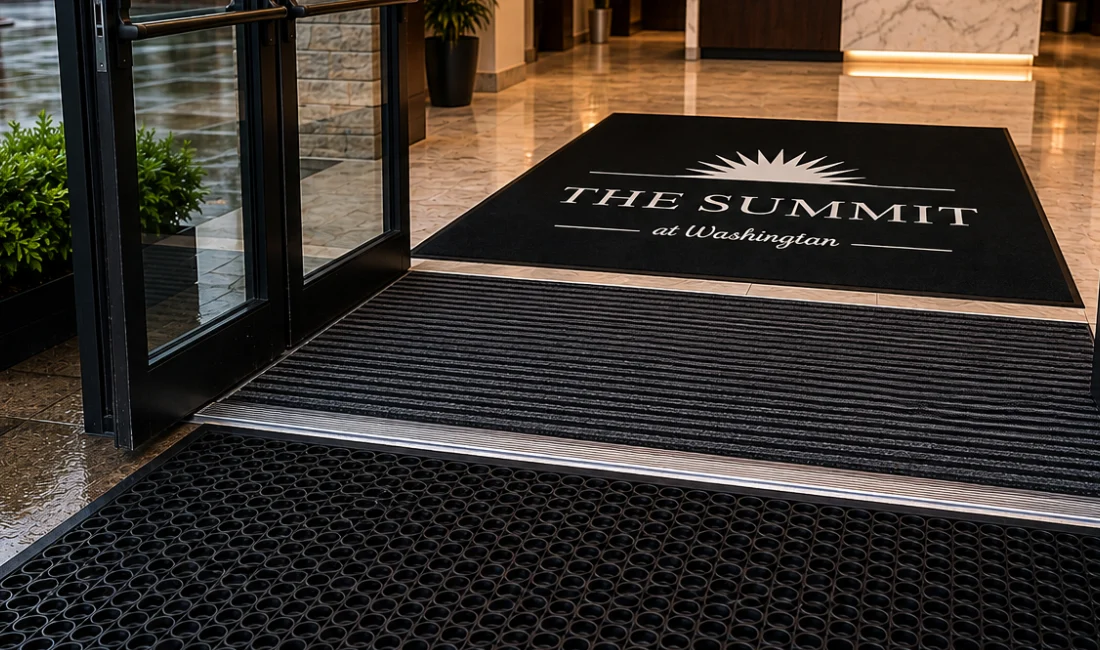
You invested in commercial entrance mats. They look good. They cover the doorway. Yet every time it rains or snows, your lobby floor is still wet. Employees are grabbing wet floor signs. Maintenance teams are mopping repeatedly. Visitors are tracking water farther into the building. In some cases, the floor around the mat is almost as wet as it would be without a mat at all.
So what is going wrong?
The answer is often surprisingly simple.
Having a floor mat is not the same as having an effective entrance matting system.
A well designed entrance system should help remove dirt, debris and moisture from footwear before those contaminants travel deeper into the building. But for that to happen, several factors need to work together, including the type of mat, its length, placement, traffic volume, weather exposure and maintenance.
Here are some of the most common reasons commercial entrances remain wet even when floor mats are already in place.
1. Your Entrance Mat May Not Be Long Enough
One of the biggest mistakes we see is choosing a mat based primarily on the width of the doorway while giving much less consideration to the length of the walking surface. Think about what happens when someone enters a building during heavy rain. Their shoes are carrying water, dirt and debris. One or two steps across a small mat may remove some of it, but often not enough. The person then steps directly onto tile, marble, terrazzo, polished concrete or another hard surface while moisture is still present on the bottom of their shoes. The result is water being carried beyond the mat. This is why commercial entrance planning should consider the number of footsteps a visitor actually takes across the matting system. A longer walk off area gives the mat more opportunities to scrape debris and absorb moisture before the visitor reaches the finished interior floor. In high traffic buildings, this becomes even more important. A small mat that may work perfectly well for a low traffic office could be completely inadequate for a school, hotel, hospital, airport, retail store or large commercial building receiving hundreds or thousands of visitors.
The question should not simply be, “What size mat fits in front of my door?”
A better question is “How much walk off coverage does this entrance need?”
That is a very different way of designing an entrance.
2. One Mat May Be Trying to Do Too Many Jobs
Not every entrance mat performs the same function. Some mats are designed primarily to scrape heavy dirt and debris from footwear. Others are designed to absorb moisture. Some are engineered to perform both functions to varying degrees. In demanding commercial environments, expecting one small mat to handle everything coming through the entrance may be unrealistic. Consider a building entrance during a winter storm.
Visitors may be carrying ,snow, water, road salt, sand mud, fine dirt, Ice melt residue
That is a lot for one mat to manage.
A more effective entrance may use different zones. An exterior or vestibule mat can begin the scraping process by removing larger debris. A secondary interior mat can continue removing moisture and finer particles. Additional walk off coverage can capture what remains before visitors reach sensitive interior flooring. This layered approach creates an entrance matting system rather than relying on a single mat to solve the entire problem.
3. The Mat May Be Saturated
A mat cannot absorb unlimited amounts of water. During heavy rain or snow, moisture can accumulate faster than expected, especially in busy facilities. Once a mat becomes heavily saturated, its ability to continue managing moisture may decrease. Visitors continue walking across it, but instead of stepping onto a relatively dry surface, they may be stepping onto a mat that is already holding a significant amount of water. That moisture can then continue traveling into the building. This is particularly important for entrances with concentrated traffic during certain periods.
- Schools experience major traffic during arrival and dismissal.
- Office buildings may experience morning and evening rush periods.
- Hotels may have heavy traffic around check in and events.
- Retail stores can experience dramatic traffic increases during weekends and holidays.
A matting system should therefore be selected not only for the physical dimensions of the doorway but also for how the building is actually used.
4. The Mat Is in the Wrong Location
Placement matters. A beautiful commercial mat positioned several feet away from the natural walking path will not perform effectively if visitors can simply walk around it. The mat should cover the path people naturally take when entering the building. This becomes especially important with wide entrances, multiple doors and vestibules. For example, if an entrance has four doors but the mat only covers the center portion of the floor, people entering through the outer doors may completely bypass the mat. Similarly, a small mat placed in the center of a large vestibule may look neat but provide very little actual walk off protection. When evaluating an entrance, look at the entire traffic pattern.
Ask:
- Where do people enter?
- Which doors are used most frequently?
- Can visitors step around the mat?
- How many footsteps actually land on the mat?
- Where does the wetness begin appearing on the finished floor?
- These observations can tell you much more than simply measuring the doorway.
5. The Wrong Mat Was Selected for the Environment
A mat that performs well inside a corporate office may not be the best solution outside a restaurant. A product designed for indoor moisture absorption may not be suitable for direct outdoor exposure. Likewise, a heavy duty scraper designed to remove mud and debris may not provide the same moisture management as an absorbent interior mat.
Before selecting a commercial mat, consider the environment.
- Is the mat indoors, outdoors or inside a vestibule?
- Is the entrance covered?
- Is it exposed to direct rain?
- Does the building experience snow and ice?
- What type of flooring surrounds the mat?
- How much foot traffic does the entrance receive?
- Are shopping carts, wheelchairs, luggage or other wheeled traffic regularly crossing the area?
The correct mat should be selected around the building conditions rather than simply appearance or price.
6. The Mat May Be Worn Out
Commercial mats do not last forever. Over time, traffic can compress fibers, wear down scraping surfaces and reduce the overall performance of the mat. The change may happen gradually, which makes it easy to overlook. A mat may still look acceptable from a distance while no longer performing as effectively as it did when new.
Watch for signs such as,
• Flattened or heavily worn fibers
• Damaged edges
• Cracking or deteriorating backing
• Excessive curling
• Areas where traffic has created visible wear paths
• Reduced ability to capture moisture and debris
Replacing a mat should not only be a cosmetic decision.
It should also be a performance decision.
7. Maintenance Is Part of the Entrance System
Even a high quality mat needs proper maintenance. Think of an entrance mat as a filter. It captures dirt and moisture so those contaminants do not travel farther into the building.
But filters need to be cleaned. When dirt builds up inside the mat, its performance can be affected. During severe weather, mats may also require more frequent attention than during normal conditions. Facilities should have a maintenance plan appropriate for the type of mat and the amount of traffic. This could include regular vacuuming, extraction cleaning, shaking or sweeping certain products, and rotating or replacing mats when necessary. Weather conditions should also influence maintenance schedules. A sunny Tuesday in June does not create the same entrance conditions as a snowy morning in January.
8. Your Building May Need More Than a Loose Lay Mat
Sometimes the issue is not the quality of the mat. The building itself may require a more substantial entrance solution. High traffic commercial buildings may benefit from recessed entrance systems, aluminum grille systems, modular systems or larger custom matting installations. Recessed systems can provide a more integrated entrance surface while helping capture debris within the system. They can also create a clean architectural appearance when properly specified and installed. However, recessed systems introduce additional considerations, including recess depth, measurements, surrounding flooring, drainage conditions, traffic direction and accessibility. This is why entrance planning is ideally considered during the design or renovation process rather than after the flooring has already been installed.
9. The Cheapest Mat Can Become the Expensive Solution
Price matters in every facility budget, but the purchase price of a mat is only one part of its true cost. When an entrance matting system does not perform properly, the additional expenses can quickly add up. Maintenance teams may spend more time mopping, wet floor signs may need to be deployed repeatedly, and interior flooring may require more frequent cleaning as dirt and moisture travel farther into the building. Over time, finished floors can experience premature wear, and poorly suited mats may need to be replaced more frequently. More importantly, excessive moisture on interior floors can increase slip and fall concerns. A lower priced mat that is not suitable for the environment can ultimately create higher operational costs elsewhere in the facility. The goal is not necessarily to purchase the most expensive mat, but to select the right matting system for the building, traffic level, environment, and application.
10. Start With the Entrance, Not the Product
This is perhaps the most important principle.
When someone asks, “What is your best entrance mat?” there isn’t always one universal answer.
The better starting point is understanding the entrance itself.
Before selecting a mat, consider:
- Traffic: How many people use the entrance?
- Exposure: Is the entrance protected or exposed to weather?
- Climate: Does the building deal with heavy rain, snow, salt or mud?
- Flooring: What surface is the mat protecting?
- Location: Will the mat be outside, inside a vestibule or inside the building?
- Available space: How much walking distance can realistically be dedicated to matting?
- Accessibility: Will wheelchairs, carts or other wheeled traffic cross the mat?
- Maintenance: How will the mat be cleaned and how frequently?
- Appearance: Does the entrance need to support the building’s architectural or branding requirements?
Once those questions are answered, selecting the right product becomes much easier.
A Better Entrance Begins With a Better Plan
If your lobby floor remains wet even though you already have entrance mats, don’t automatically assume you simply need another mat.
- Look at the entire entrance.
- Look at where people walk.
- Look at how many steps they take across the mat.
- Look at where water begins appearing.
- Look at the type of debris entering the building.
- Look at whether your existing mat is saturated, worn or incorrectly positioned.
- The solution may be a different mat.
- It may be a longer mat.
- It may be additional walk off coverage.
- It may be a combination of scraping and moisture control products.
- Or it may require a more complete entrance matting system.
- The goal is not simply to put a mat at the door.
The goal is to stop as much dirt and moisture as practical at the entrance, before it becomes a problem throughout the building.
Need Help Evaluating Your Commercial Entrance?
Every building is different.
Universal Floor Mats works with commercial facilities, contractors, property managers, schools, hospitality properties and other organizations to help identify appropriate entrance matting solutions. If your current entrance mats are not performing the way you expected, send us a photo of the entrance along with approximate measurements and information about your traffic and environment. Our team can help you evaluate what may be missing and recommend an entrance solution based on the needs of your facility.